
There are 5 licensed addiction treatment facilities in Leon County, in Tallahassee. Of these, 2 offer detox, 1 provide residential care, 2 run intensive outpatient programs and 5 offer medication-assisted treatment. 5 accept Medicaid, 3 take private insurance and 3 offer a sliding fee scale.
Premier spot available
Feature your facility right under the search bar on county, city and treatment pages.
Advertise hereRehab Centers in Leon County
Facilities marked Ad are paid Premier and Featured listings and appear first. All other facilities are listed by distance, or alphabetically when no location is given. How we sort results
DISC Village Inc – Leon County Human Services Center
1000 West Tharpe Street, Suite 14, Tallahassee, FL 32303 1.3 mi
- Intensive outpatient (IOP)
- Outpatient
- Medication-assisted treatment (MAT)
- Dual diagnosis
- +1 more
Metro Treatment of Florida LP – DBA New Season Treatment Center 28
425 Office Plaza Drive, Tallahassee, FL 32301 1.4 mi
- Detox
- Outpatient
- Medication-assisted treatment (MAT)
- Dual diagnosis
- +1 more
Tallahassee Outpatient Annex – North Florida South Georgia VA Health
2181 East Orange Avenue, Tallahassee, FL 32301 3.8 mi
- Intensive outpatient (IOP)
- Outpatient
- Medication-assisted treatment (MAT)
- Telehealth
Leon County Treatment Center – New Season Treatment Center 7
3976 Woodville Highway, Tallahassee, FL 32305 5.2 mi
- Detox
- Outpatient
- Medication-assisted treatment (MAT)
- Dual diagnosis
- +1 more
DISC Village Inc – Sisters in Sobriety
2967 Natural Bridge Road, Tallahassee, FL 32305 11 mi
- Residential / inpatient
- Medication-assisted treatment (MAT)
- Sober living
- Dual diagnosis
- +1 more
Guide to Rehab in Leon County
Leon County Florida Opioid Crisis
In April of 2023 the Leon County Sheriff Walt McNeil is issued a public warning regarding the dangers of fentanyl-related drug overdoses, following the occurrence of five separate incidents. In these incidents, seven individuals mistakenly consumed prescription pills they believed to be Oxycodone or Percocet. Fortunately, no there were no fatal overdoses, as first responders equipped with Narcan, a medication used to reverse opioid overdoses, successfully revived all the victims.
In the center of the opioid crisis is Fentanyl, a highly addictive synthetic opioid commonly used for pain management. Fentanyl is significantly more potent than heroin (50 times) and morphine (100 times). Even minuscule amounts can prove fatal. Illicit drug suppliers are increasingly combining fentanyl with other illegal drugs, both in powder and pill form, to foster addiction and entice recurring buyers. When incorporated into pills, fentanyl becomes virtually undetectable to the naked eye, making it difficult to distinguish from genuine medication. This disturbing trend has led to numerous overdose cases, where victims unknowingly ingest fentanyl and suffer fatal consequences.
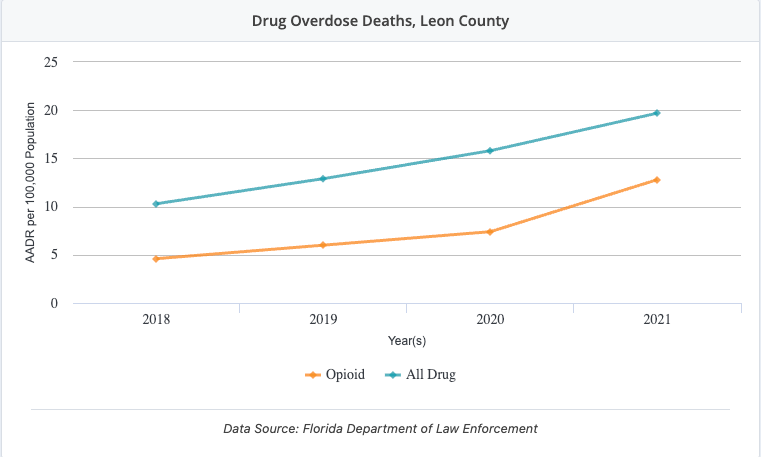
Data from the Florida Department of Health
The latest data from the Florida Department of Health reveals that in 2020 alone, over 6,150 individuals in the state died from fentanyl-related overdoses. Preliminary figures from 2021 indicate a further increase in the number of deaths. Nationwide, the Centers for Disease Control and Prevention (CDC) estimate that during the 12-month period ending in October 2021, over 105,000 Americans succumbed to drug overdoses, with 66 percent of those deaths attributed to synthetic opioids such as fentanyl. Remarkably, fentanyl poisoning surpassed suicide, gun violence, and car accidents to become the leading cause of death among adults aged 18-45 in the United States last year.
Never Accept or Consume Pills Unless Prescribed Your Doctor
LCSO (Leon County Sheriff’s Office) advises citizens to never accept or consume pills that have not been directly prescribed by a licensed physician. It is crucial to remain vigilant regarding the signs of a fentanyl overdose, which can occur much faster and with greater intensity compared to a typical opioid overdose. Indications of a fentanyl overdose include bluish lips or fingertips, unresponsiveness to a sternal rub, bodily stiffness, frothing at the mouth, and confusion.

Leon County Florida Fighting the Opioid Crisis
Tallahassee and Leon County have filed lawsuits against several pharmaceutical companies, including Purdue Pharma, Cephalon Inc., Teva Pharmaceuticals, Janssen Pharmaceuticals, and Endo Health Solutions. These lawsuits are based on federal fraud and racketeering laws and are expected to be part of a larger multi-district federal litigation in Ohio.
The purpose of the lawsuits is to seek recovery for any damages incurred by the city and county due to the opioid epidemic. The claims assert that the companies engaged in misleading advertising and other deceptive tactics, leading to widespread addiction and a public health risk.
The legal actions mirror a nationwide effort to hold pharmaceutical companies accountable, similar to the litigation against the tobacco industry. Tallahassee and Leon County are taking this step in response to an excessive number of opioid prescriptions in the area, which has resulted in drug dependence and non-medical use of pain relievers among residents.
These lawsuits aim to eliminate the hazards posed by the opioid epidemic, abate the associated nuisances, and recoup the funds spent by the city and county due to the defendants’ deceptive marketing and unlawful distribution of prescription opioids.
Leon County Sheriff’s Office and Drug Enforcement Administration Work Together for Public Safety
Fighting the opioid epidemic is imperative in Leon County and throughout Florida. In early 2021, investigators with the Leon County Sheriff’s Office and Drug Enforcement Administration arrested a Tallahassee resident that was sentenced to 239 moths in federal prison for distribution of Fentanyl. Both agencies developed information that the Tallahassee resident, who was then serving a court-ordered supervision for conspiracy to distribute cocaine and cocaine base, had resumed his illegal trafficking activities.
Investigators quickly conducted two controlled purchases of what was initially thought to be heroin, but subsequently tested positive as 14 grams of fentanyl. Upon his indictment, the Tallahassee resident was immediately taken into custody where he has remained pending sentencing.
“Last year, 68% of the American lives lost to drug overdoses and poisonings were due to an illicit synthetic opioid, like fentanyl, the same poison that this Tallahassee resident was distributing in his community,” said Drug Enforcement Administration Miami Field Division Special Agent in Charge Deanne L. Reuter. “This sentence not only holds this Tallahassee resident accountable for his crimes, but also reaffirms the Drug Enforcement Administration Miami Field Division’s commitment to working closely with our law enforcement partners to bring those who distribute this poison in our North Florida communities to justice.”
Operation No Warning
Tallahassee, Fla. – Florida Department of Law Enforcement agents, along with Leon County Sheriff’s Office, Tallahassee Police Department and Florida Highway Patrol, arrested 27 suspects charged with drug crimes, including wide-scale drug trafficking in Leon and Gadsden counties. Investigators say the drug-trafficking organization was responsible for spreading large amounts of illegal drugs including cocaine, crack cocaine, heroin, methamphetamine, molly and marijuana throughout Florida, but predominantly in Leon and Gadsden counties. The organization also operated in Georgia, Texas and California.
During the investigation agents seized:
- nearly 30 pounds of cocaine,
- a half pound of methamphetamine,
- more than one pound of brown heroin,
- three ounces of black tar heroin,
- over two ounces of fentanyl,
- more than $330,000,
- nine firearms, and
- three stolen vehicles.
Attorney General Ashley Moody’s Office of Statewide Prosecution and State Attorney Jack Campbell’s Office assisted in the investigation and will prosecute the cases.
“We are in the midst of a national opioid crisis claiming the lives of nearly 17 people a day in our state. When you factor in other deadly drugs, the mortality rate rises even higher. The people who peddle these poisons must be brought to justice, and multiagency operations like this one are so vital to our mission to end the opioid crisis and save lives. Not only did law enforcement confiscate heroin during the operation, they also seized enough fentanyl to kill approximately 28,350 people—that’s almost equal to the populations of Franklin, Lafayette and Liberty counties combined.
”I am proud to work with FDLE, FHP, State Attorney Campbell, Sheriff McNeil and Chief Revell to coordinate and execute this sophisticated operation that led to the takedown of this massive, multistate drug-trafficking ring. My Statewide Prosecutors will aggressively litigate this case to ensure these drug traffickers face justice.” Attorney General Ashley Moody
Leon County Marchman Act for Substance Abuse Help
The Marchman Act involves local governments and is part of Florida law helping those with an alcohol or substance abuse problem find an addiction treatment program. This resource in Leon County, Florida was designed to assist a resident of the county find help. In addition it was created to help families who have a loved one in trouble with alcohol, substances like fentanyl or other opioids in finding court-ordered drug and alcohol treatment under the Marchman Act.
Similar circumstances apply for the Baker Act addressing mental health.
This invaluable service is available in the following Leon County cities:
- Tallahassee
- Woodville
The Marchman Act offers a lifeline for those seeking involuntary addiction treatment in Leon County, Florida. When individuals are unable to recognize the need for addiction treatment, the Marchman Act empowers the court to evaluate them and mandate attendance at private or state-funded rehabilitation facilities within Florida.
This program provides a crucial pathway for both children and adults to access the treatment they require, as long as they meet the specific requirements outlined by the Marchman Act in Florida. To secure a court-ordered assessment and potential treatment, the individual must be refusing treatment and their addiction must pose a threat to themselves or others.
Important Locations for the Marchman Act in Leon County:
Filing Location:
301 S. Monroe St., Tallahassee, FL 32301
Marchman Act Receiving Facility:
Apalachee Center for Human Services
2634 Capital Circle NE, Tallahassee, FL 32308
Key Information about the Marchman Act in Leon County:
Once a petition is filed, a hearing will be scheduled within 10 days. Ensure that you file your petitions with the Clerk of Court. In Leon County, the default procedure is Ex Parte, which means that if the petition is granted, the individual under the court order will be promptly transported to the treatment center and must remain there for 72 hours.
If you are the petitioner, it is essential to actively follow up with the Apalachee Center for Human Services to pursue mandatory treatment. Present your filings to the Clerk of Court before 3:30 PM on business days to allow ample time for processing before the office closes.
Substance Abuse and Addiction Services in the County of Leon
- Alcoholics Anonymous (AA) 24-hour Hotline (850) 224-1818
- Apalachee Center (850) 523-3333
- Big Bend Area Narcotics Anonymous (NA) NA Hotline (850) 224-2321
- Celebrate Recovery, Killearn UMC (850) 893-1116
- DISC Village, Inc. Adult Services (850) 561-0717
- DISC Village, Inc. Juvenile Outpatient (850) 561-0717
- Life in Focus ~ ACTS (850) 877-2287
- Life Recovery Center, A (ALRC) (850) 224-9991
- TMH, Behavioral Health Center (850) 431-1155
- Tobacco Free Florida / AHEC 1 (877) 848-6696
- Townsend ARC (850) 656-5112
- Woodlands Camp (850) 574-CAMP or (850) 574-2267
Sources:
https://www.fdle.state.fl.us/News/2021/April/27-arrested-in-Operation-No-Warning
Common Questions About Rehab in Leon County
Are there detox centers near Leon County?
Yes. 2 of the facilities listed here offer detox, including Metro Treatment of Florida LP – DBA New Season Treatment Center 28 and Leon County Treatment Center – New Season Treatment Center 7. Medical detox is often the first step for alcohol, opioid, or benzodiazepine dependence, because withdrawal from these can be dangerous without supervision.
Do rehabs near Leon County accept Medicaid?
5 of the 5 facilities listed accept Medicaid, and 3 offer a sliding fee scale based on income. Call the facility to confirm they are taking new Medicaid patients.
What is the difference between inpatient and outpatient rehab?
Residential (inpatient) programs have you live at the facility, usually for 30 to 90 days, and suit people who need structure or a break from their environment. Outpatient and intensive outpatient programs let you live at home and attend treatment during the day or evening. Near Leon County, 1 facilities offer residential care and 2 offer intensive outpatient programs.
Is there free or low-cost rehab near Leon County?
Some options are available. Near Leon County, 3 facilities offer a sliding fee scale based on income, 5 are state or federally funded, and 3 offer payment assistance. Call ahead to ask what you would pay.
Which cities in Leon County have rehab centers?
Treatment facilities listed here are in Tallahassee (5). Choose a city page for the closest options, or use the search to filter by type of care and insurance.
Can I get medication-assisted treatment near Leon County?
Yes. 5 facilities near Leon County offer medication-assisted treatment (MAT), which combines medications such as buprenorphine, methadone or naltrexone with counseling. See MAT programs in Florida to learn how it works.
